Heavy Fuel for Tactical UAVs: Why It Is More Difficult Than It Looks
Updated: Jul 24
Heavy fuel compatibility has become an operational requirement for modern tactical UAVs, driven by the need to integrate with existing military fuel infrastructure while improving safety and simplifying logistics. Achieving this capability in small hybrid propulsion systems, however, is far more complex than replacing one fuel with another.
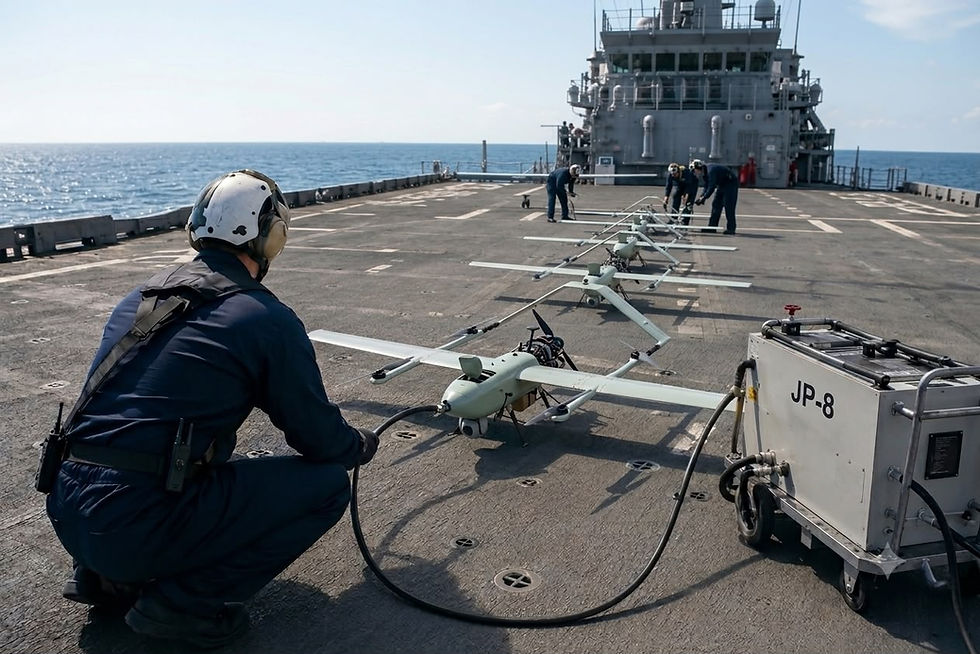
Heavy fuel introduces significant challenges in ignition, combustion stability, and reliable in-flight restart. Lowental Hybrid addresses these challenges through its Native Parallel Hybrid™ architecture, combining high-RPM operation with an integrated thermal management solution to enable dependable heavy fuel operation without compromising endurance, reliability, or mission performance.
Why Heavy Fuel Matters
For decades, heavy fuel has been the standard fuel across military aviation. Fuels such as JP-8 and Jet A-1 simplify logistics by allowing aircraft, generators, and other equipment to operate from a common supply. The usage of heavy fuel also plays a key role in enhancing safety, specifically in maritime applications.
As tactical UAVs become integrated into military operations, compatibility with these fuels has become an operational requirement.
Yet while heavy fuel operation is well established in larger UAVs, implementing it in small tactical propulsion systems presents a very different engineering challenge.
The challenge is how to preserve reliability, cold start capability, performance, and operational simplicity while using a fuel with fundamentally different combustion characteristics.
Why Heavy Fuel Is Challenging
Gasoline engines rely on a fuel that vaporizes relatively easily. Heavy fuel behaves differently.
Its lower volatility makes ignition considerably more difficult, particularly at low temperatures where fuel atomization and vaporization become less efficient. For conventional engines, this is already a challenge during cold starts.
For the hybrid tactical UAV architecture, the problem becomes even more demanding.
The intentional shut down of the combustion engine during parts of the mission to reduce acoustic signature or optimize energy management is a key feature in the hybrid architecture. The propulsion system must therefore be capable of restarting the engine in flight, potentially after prolonged exposure to low ambient temperatures at altitude.
A propulsion system that performs well on the ground but cannot reliably restart in flight is of limited operational value.
Heavy fuel introduces another engineering consideration: combustion stability.
Under certain operating conditions, heavy fuel is more susceptible to abnormal combustion, commonly referred to as detonation or knock. Left unmanaged, detonation reduces efficiency and may lead to long-term engine damage. Characterizing and avoiding this operating envelope is therefore a critical part of heavy fuel development.
Taken together, ignition, restart reliability, combustion stability, and performance validation make heavy fuel development substantially more complex than fuel substitution alone.
From Feasibility to Validation
At Lowental Hybrid, heavy fuel development began in response to growing customer demand from defense organizations seeking compatibility with existing military fuel infrastructure.
The relevance of heavy fuel is particularly pronounced in the U.S. defense ecosystem, enabling single standardized fuel usage across various defense applications.
Heavy fuel compatibility allows unmanned systems to integrate into existing military fuel infrastructure while benefiting from the fuel's lower flammability, improved storage characteristics, and suitability for systems that may remain in storage for extended periods before deployment.
As tactical UAS become increasingly distributed across operational units, the ability to operate on standard military fuels is becoming an important enabler of fielding and sustainment, not simply a propulsion feature.
To address this requirement, our engineering team evaluated whether the company's existing Native Parallel Hybrid™ architecture could support heavy fuel while preserving its operational capabilities.

The first objective was to determine whether the propulsion unit could sustain operation on heavy fuel. Initial feasibility testing demonstrated successful engine operation after transitioning from gasoline to heavy fuel under controlled conditions.
A key advantage of the LH propulsion architecture is its high-RPM operation. This operating regime minimizes the risk of detonation when running on heavy fuel, while the high engine cranking speed contributes to a consistently high engine start success rate.
Comparative testing was conducted to evaluate engine performance across gasoline and heavy fuel operation, including specific fuel consumption (SFC) testing to provide a detailed understanding of efficiency across the operation envelope.
Reliable in-flight ICE start is a defining feature of the Native Parallel Hybrid architecture, which led our engineers to develop an integrated thermal management solution to address heavy fuel's more demanding ignition characteristics.
Due to the low thermal mass of the small internal combustion engines (ICEs) used in the LH series propulsion systems, relatively little energy is required to bring the engine to its optimal ignition temperature. As a result, the systems demonstrate fully automatic engine restart in less than two minutes.
Looking Beyond Initial Capability
Development does not end once an engine runs successfully on heavy fuel.
Current work includes detailed combustion analysis using dedicated knock detection equipment to map the engine's operating envelope and validate long-term reliability.
This validation process reflects an important distinction between demonstrating capability and engineering a deployable product. Military propulsion systems must not only function, but do so repeatedly, predictably, and across realistic operating conditions.
Heavy Fuel as Part of the Energy Architecture
As tactical UAVs evolve, propulsion systems are increasingly expected to satisfy multiple operational requirements simultaneously: extended endurance, low acoustic signature, reliable autonomous restart, reduced logistics burden, and compatibility with military infrastructure.
Meeting those requirements requires more than adapting an engine to a different fuel. It requires designing an integrated propulsion architecture capable of balancing combustion, thermal management, electrical power, and operational reliability as a single system.
That is ultimately why heavy fuel remains a significant engineering milestone for small tactical UAVs. The challenge is not making an engine run on JP-8 or Jet A-1. The challenge is delivering the same operational performance that operators already expect, while using the fuel they already carry.


Comments