The Accessibility Challenge: What It Really Takes to Bring Tactical UAVs to the End User
Doron Fridman, CEO, Lowental Hybrid
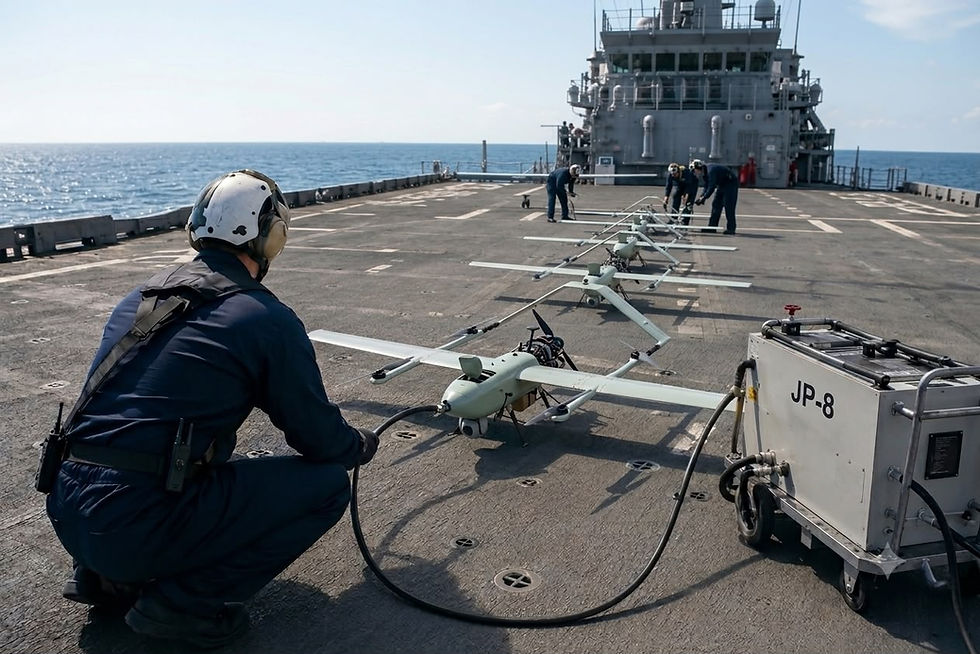
Featured image source: https://www.groundcontrol.com/
Unmanned aerial systems were once the domain of large organizations with trained operators and dedicated infrastructure. That era is long over. Today, the air domain is increasingly populated by simple, accessible systems used by non-expert tactical teams. This shift was driven by advances in electric propulsion, control systems, and sensor miniaturization, but the revolution is not complete. Operational demands are rising fast, and what worked yesterday no longer meets the needs of today’s battlefield.
The challenge is not simply to make drones easy. It is to deliver performance that approaches complex, high-end platforms while preserving the simplicity, robustness, and small form factor required at the tactical edge. A system that is easy but underperforms offers little operational value; a system that delivers performance only by becoming large or complex will never reach the users who need it most.
This article examines the core obstacles to true accessibility: launch and recovery, endurance and energy, and the cognitive load created by modern sensors and data. Understanding these barriers clarifies why propulsion architecture is not a background choice. It is the central determinant of who can actually use a UAV in the field.
1. Launch and Recovery: The Practical Barrier
Small tactical teams work without runways, hangars, or professional pilots. Their requirements are consistent across theaters: autonomy, repeatability, terrain independence, and minimal training.
Traditional solutions offer benefits but also clear constraints. Launch rails and catapults are compact and familiar, but they introduce logistical and operational complexity that does not always align with the realities of the battlefield. They also address only the launch phase: for reusable platforms, the inability to support controlled, repeatable landings is a fundamental limitation.
VTOL configurations, now the most common approach, solve the recovery problem yet impose significant penalties: additional lift motors add permanent weight, the airframe carries constant drag, and hover or transition phases consume substantial energy that directly reduces endurance. More advanced concepts—such as tilt-rotor mechanisms or variable-angle engines—promise elegance but add mechanical complexity, integration challenges, and potential reliability concerns.
Evaluations of small VTOL fixed-wing aircraft repeatedly show substantial reductions in usable endurance compared to clean fixed-wing equivalents - sometimes up to 40-50% reduction. The numbers vary, but the trend is consistent.
This raises the first operational truth: the easier it is to launch and recover a UAV, the harder it becomes to give it meaningful endurance - unless propulsion efficiency compensates for the penalties. Accessibility begins with takeoff, but propulsion determines whether that accessibility produces operational reach.
2. Endurance and Energy: The Group-2 Paradox
Endurance is the foundation of tactical value. It determines whether a system can reach the area of interest, remain long enough to observe or influence it, and still return with useful information. Endurance, however, is dictated by energy available per kilogram. And in the field, size is not negotiable.
Militaries increasingly rely on fixed-wing Group-2 UAVs because they have relatively high aerodynamic efficiency and are deployable by one or two operators, move easily with small units, create low acoustic and visual signatures, and impose minimal logistics. The underlying challenge, however, is rooted in physics. Fuel provides several times the energy density of batteries, making it extremely attractive for small airframes. But small airframes also limit the size of the combustion engine that can be installed. To cover the full mission profile, the engine must be large enough to deliver sufficient power - yet the moment it grows, it consumes the weight budget needed for fuel.
This creates a hard trade-off: fuel-powered systems require engines that are disproportionately large for the airframe, leaving too little fuel to achieve long missions; electric systems use lightweight motors, but the batteries required to reach meaningful endurance are extremely heavy, and remain heavy even when depleted. The result is a structural paradox that keeps most Group-2 platforms battery-powered and inherently short-endurance.
The result is a paradox: soldiers need long endurance, yet they cannot field larger systems. Small airframes restrict both engine size and energy storage, and no combination of conventional solutions avoids the trade-offs. Battery-electric designs typically provide one to two hours of real endurance—and even less once VTOL penalties are added. Fuel propulsion can offer far more, but historically demanded airframes large enough to exceed the tactical envelope. This contradiction cannot be resolved through aerodynamic refinements or software optimization alone. At its core, it is a propulsion problem.
3. Information Load: The Cognitive Barrier
The final barrier to accessibility is no longer mechanical. It is cognitive.
Modern tactical UAVs carry multi-sensor gimbals, mapping payloads, RF receivers, acoustic detectors, and navigation redundancy modules. These payloads are power hungry, and they generate far more data than a soldier under stress can parse in real time.
A single operator cannot track multiple video streams, telemetry, multispectral indicators, and electronic warfare alerts while also making tactical decisions. Accessibility now means simplifying what the soldier sees without reducing what the platform does. That requires onboard edge processing, sensor fusion, and user interfaces that elevate only mission-critical elements.
These requirements have two consequences. First, they increase continuous electrical load. Second, they demand energy reserves not only for propulsion but also for computation. The propulsion architecture therefore shapes the effectiveness of the sensor suite, not just the aircraft’s flight time.
4. The Case for Parallel Hybrid Propulsion
When all three barriers are viewed together, a clear pattern emerges. Automatic launch and recovery are essential for true accessibility, but they impose significant energy costs and add drag. Long endurance is required in every mission profile, yet remains out of reach due to strict weight limits. And meaningful information accessibility demands onboard processing power and increasingly capable sensors, which in turn require substantial electrical energy.
These constraints cannot be overcome through airframe refinement or software alone. To break through them within the size and simplicity of Group-2 systems, a fundamental shift in propulsion is required. The key is hybridization: not VTOL hybridization, but propulsion hybridization—where a piston engine and an electric motor work together on the same propeller, each providing power when it is most effective. And the real sophistication lies in achieving this with the lowest possible mass, so that none of the limited weight budget is wasted.
How hybrid addresses launch and recovery
Electric power supports stable, quiet takeoffs and controlled approaches without adding redundant propulsion systems. Cruise penalties from VTOL can be offset by more efficient fuel-based propulsion, keeping the airframe within Group-2 limits.
How hybrid improves endurance
Hybrid aircraft combine high-density fuel for efficient cruise with electric power during demanding phases of flight. Low system weight is achieved by using a low volume EFI engine that is optimized for cruise. The result is long endurance without growing battery mass and a significant expansion of loiter time inside a small tactical envelope.
How hybrid supports the information load
Parallel hybrid propulsion provides continuous charging for the electrical system, stable power for multiple sensors, and reserve energy for AI-based processing. The presence of two independent power sources also introduces graceful failure modes that enhance survivability.
Hybrid propulsion therefore connects the mechanical, energetic, and cognitive dimensions of accessibility into one coherent architecture.

Conclusion: The Real Metric of Accessibility
Tactical UAVs face three uncompromising constraints: how they launch and recover, how long they remain useful in the air, and how much cognitive burden they place on the operator. Parallel hybrid propulsion is the only architecture that addresses and enables all three simultaneously while remaining inside Group-2 size and logistics.
It mitigates VTOL penalties through efficient cruise. It delivers long endurance without forcing the airframe into a larger class. It provides the electrical power required for modern sensors and onboard intelligence. It offers redundancy and flexibility that directly influence survivability.
Accessibility is not about who can own a UAV. It is about who can extract real operational value from it under pressure, in unprepared terrain, and with minimal support. The winning designs of the coming decade will be those that combine small-form usability with the energy and intelligence required to influence modern, information-heavy battlefields. Hybrid propulsion is a key part of that shift.
Selected Sources and Further Reading
Beloit College Chemistry — Energy Density Table https://chemistry.beloit.edu/edetc/SlideShow/slides/energy/density.html
UNEP / DTU — Battery PACK-level Energy Density https://c2e2.unepccc.org/wp-content/uploads/sites/3/2019/09/analysis-of-hydrogen-fuel-cell-and-battery.pdf
Journal of Intelligent & Robotic Systems — Quad-plane Drag Penalties https://link.springer.com/article/10.1007/s10846-020-01264-3


Comments